










Recent Posts | Share a Tip | Back to Basics | Reader Photos | Forum | Subscribe
Home Studio | Tutorials | Readers Projects
The following tutorial on building an Ariel Monopod is a guest post by Adam Hajnos.
Recently I was carrying around my camera and tripod at a music festival when I got the idea to do an aerial shot. I extended the tripod out all the way and put the camera on a timer. Only problem is, my tripod weighs upwards of 50lbs. So here is a simple solution to make a lightweight, portable monopod for "aerial" photography.
Here's what you'll need to get started. I got everything for around $15. But the most expensive part was the roller. Home Depot has a 30 Foot pole for $40 which I may get someday. But for now I went with an 8 footer (see: 6 Foot, Mega 16 Foot).
If you don't have a tripod head, you can just use a 1/4" Hangar Bolt and screw in directly to the camera.
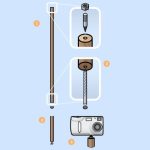
Here's what the end on the paint roller extension rod looks like. It's a 3/4" bolt. We need it to fit a 3/8" bolt.
The bolt is 3" long, and we need it to stick out 0.5". So I put the bolt next to the wooden extension and measures half an inch below the bolt.
Once you cut the wood, it should be about 4 inches tall. Next we need to find the center of the wood.
I just eyeballed the center, I drew two straight lines and marked where they met. Next, we need to drill out a hole that is 3/8" wide so we can put our hanger bolt in the wood. Clamp down the shaft and begin to SLOWLY drill out the wood. Make sure you keep your drill level so you don't poke thru the sides.
Insert the sharp end on the hangar bolt (one side is for wood, the other has a tighter thread for metal) Grab the sides of the bolt and twist until there is only 0.5" sticking out. Be careful not to mess up the threads with the pliers. I tried to only grab the threads down low, since they would not be used. Once you are done, glue your washer on the end (optional).
Here it is with the tripod head attached.
And the final product, fully extended (no camera on top, of course).
Here's a shot, with my fish eye lens about 9ft up in the air. I also made the paint roller extension rod with a strap - you can view that tutorial here.
So, how do you trigger the camera? There are two options here: you can either use the built in timer function (like the picture taken above), or you can use an infra red remote.
Side Note 1 - this will work with ANY paint roller extender. I wonder what's the biggest one they have
Side Note 2 - While you are completely free to use this monopod with any camera you want - make sure it is tight and fastened before you mount a Nikon D3 or a Canon 1DS MK3 on the ball head.
Side Note 3 - The higher you go, the harder is it to control the frame. I suggest using very wide lenses.
Make sure you don't miss out on the next article - Register to the RSS feed or the newsletter.
This is also a good opportunity to remind you all that the At My Home Photo Contest is still running on the next two weeks. We've got some great submissions - you can see them here.
Here Are Some More Tripod Ideas:
- Cheap Mini Monopod
- The Super-Small Bottle-Cap Tripod
- Just a Washer And a Bolt - An Ingenious Camera Stabilizer
- The DIY Magic Arm
- The DIY Gorilla Pod
Comments
I recently purchased the
I recently purchased the same paint roller, which I find to be FLIPPIN AWESOME as it collapses the way it does and fits snuggly in gear bags along side umbrellas and light stands with ease and it does so in the coolest fashion (think about those crazy spears in the movie Stargate).
I would however like to suggest an alternative to the roller extension/hanger bolt that might save someone's fingers, or for those of us without nasty digit slicing table saws...as well as provide a much more secure and reliable platform for your uber expensive photo gear.
I opted to use a 3/4th PVC endcap (numerous shapes/sizes available at Home Depot's plumbing section). With the end cap, simply tap and sink a proper size 3/8th bolt into it and epoxy it inside (use some heavy duty stuff), with the amount needed protruding.
The end caps cost maybe $0.70 cents, bolts are $0.15 or so if I recall..and epoxy should be no more than $4.00 for some JB Weld. (All prices based on my hazy recollection).
This also works as a great boom for an off camera speed flash to be used for on location hair highlights or general back lighting. Just throw on a stud and a swivel mount.
One final note is that the threading on the PVC end cap is smaller than that on most, if not all, paint roller rods so it would be best to epoxy it on to the rod after the bolt has been added to it. I've found it still screws on and has a very tight and secure fit, but better safe than sorry.
A couple of advantages:
1: No sawing required, only a quick drill hole for the bolt to go through the end cap.
2: More compact compared to the above listed method of using a cut up rod extender. At the risk of sounding like a spam subject line, you'll gain 4" GUARANTEED!
3: Hands down more durable than the cheap plastic and wood on the extender. Frankly I wouldn't trust my $3k+ camera on top of that thing. It even looks like the wood is cracked in one of the images above!
Anyone who promises me to gain 4"...
John,
I have not built mine yet, but I am going to go with the epoxy and cap when I do soon. Avoiding the need to drill is a great bonus.
Roller Aerial Monopod
Ingenious! I admire out of the box thinking, especially when saving money is the result. This is a simple, inexpensive solution - an engineer's dream.
Aerial monopod
If there's any play at all between the wood/bolt assembly and the tripod head, I'd be awfully nervous about the wood splitting while the camera is attached, bringing the camera crashing to the ground.
Suggestion
I made a paint roller monopod more than 20 years ago and I'm still using it today. :-) Instead of wood I used epoxy to set the tripod bolt directly into the large end of the paint roller extension. This makes for a much more durable and secure monopod.
To set the screw use something like JB Weld or Mighty Putty. (yea! Mighty Putty)
I put a rubber crutch-foot over the big plastic "threads" where the paint roller would go. Also added some handlebar tape to make a nice cushy grip for carrying it around .
be careful with the wooden
be careful with the wooden part - it is extremally weak point of this project, I've tried that solution with other project (hopefully not to hold my camera) and the wooden part cracked... :/
remote camera control
For controlling the camera, connect it via USB to a laptop I do this with a Canon G7. Use a USB extended to get the length of cable.
I love this idea...
I really enjoyed reading this article, something I certainly will be trying - espcially now I have my new 10-20mm Sigma lens. Another Summer photography project to add to the ever growing list :)
PAP
Yep, it's known as Pole Aerial Photography. Thanks for detailing the construction of this gear.
Couple additional ideas
People have pointed out the wood as a weak point. I'd go a step further and suggest that, even if improved, the homebrew mount at the top of the pole is still the unknown entity. With that in mind, a failsafe might be to attach a clip just below the mount and clip the camera strap in. Then if the mount fails, the camera will be caught after a few inches instead of 8-30 feet. I would also suggest wrapping the camera strap around the pole such that the clip is only keeping the strap from sliding down the pole rather than taking the full weight as the camera falls.
Second, the note mentions using wide angle because it gets hard to aim the camera with longer lenses. Placing the user end of the pole on a mount would allow the camera to be raised to the same point each time. This would allow adjustments to be made and, after a couple tries, the perfect shot acquired even with a longer lens.
Just in case
If you are worried about the camera falling, try attaching a wrist strap to the top of the pole. You might be able to jb weld a d-ring up there for this purpose.
Great idea, Dankman
Those D-rings are always handy. I recomend using one with anything you mount on a wall or a pole.
Quick & dirty test run!
What a great idea! I hit HomeDepot this weekend and bought the 23' telescoping paint roller for like $35. I was eager to see some pix/video so I didn't bother putting a mount on the end at all initially, I simply duct-taped my sport/bullet camera (with integrated video recording) to the end and sent it aloft.
Man-handling a 23' pole is a trick! Even the small weight of the mini-camera felt huge when the pole started to bend over; I kept thinking it would buckle but it didn't. Also, when even a slight wind grabs it the entire pole will sway wildly. But it returned some fun initial results.
It might also be useful to have a "flag holder's belt"(?) or whatever they call those belts with the little cup on them to help hold a flag when you're walking in a parade, etc.
I've made various setups
I've made various setups like this over the years. What I've ended up with for mounting is this. Get a Mr Longarm angle adaptor (picture here http://tinyurl.com/68dm98). I picked mine up at Home Depot. It's an adjustable swiveling extension for a paint pole. Unbolt the two pieces and bolt a monopod head on to the part with the female pole thread. You will probably need a new shorter bolt for this. It's a 1/4-20 thread, a standard tripod thread.
I've got a Bogen/Manfrotto quick release swivel head on mine, like this http://tinyurl.com/3zr3c3. You need the swivel to get your camera back to a landscape orientation. The quick release is very handy as well.
The whole thing is very simple and solid and doesn't depend on shop made connections, which is nice. Also nice is that you don't need any tools to make it.
I've considered pinning the adaptor to the pole, but haven't found it necessary. I would probably just drill through the whole assembly and bolt it if I did.
If your camera is so equipped a wired remote switch is a nice way to fire this sort of thing off. With one of those marching band flag carriers you'd really be ready to go!
And the Shur-line Easy-Reach poles really are nice, mostly because they collapse to a third rather than half their extended length.
Damaged thread
The idea looks so good i've got to add it to my list of things to do, as you mentioned that using pliers on the thread may damage it, i recently used the hanger bolts for a different job, an all you need is to get a couple of nuts to run on the thread, then you use these to turn the bolt as they will not move once next to each other
saved by your blog!
I almost lost a commercial job because the city demanded too much in the way of permitting and insurance for a lift-truck to shoot from up high. But then I found your blog post and I was able to do the job after all (and keep some of the money that the client otherwise would have spent on a lift-truck). So thanks very much! You can read about it here.
re: Playground
Hi Matt,
I am glad it worked out for you. you have some great strobist lighting going there.
a belated thanks for your
a belated thanks for your kind words!
Variation on the theme
I really liked this idea. I also wanted something more versatile and needed a regular monopod, so I took the basic idea and modified it. This version requires minimal tools and effort and I threw it together in less than 30 minutes. The only tool you need is a drill.
Parts:
Take the PVC end cap and drill a 1/4" hole through the end, be sure to drill a pilot hole first and either clamp or hang on tight. Even with the pilot hole it spun on me when I went to the 1/4" bit. Insert the machine screw through the hole so the threads stick out. Get the epoxy putty out and knead it as per directions, then fill the end cap with it. "Screw" the angle adaptor into the putty before it sets (note: the stuff I used starts setting in 3 minutes) and smooth the excess around, hopefully you'll manage a neater job than I did before the putty starts to solidify. Let the putty cure. Because there's threads on the inside of the end cap and the outside of the angle adpator, this should hold fairly well. The end result is below.
You now have an adaptor bit that can be put on different extension rods, depending on the size you need. Put a rubber chair tip on the handle of the extension rod for traction, and you're ready to go. If you just need a monopod, You can use a shorter extension rod, say a 30" collapsed - 60" extended rod (the adaptor will add about 8" if it's set straight). If you want to do a high aerial, you can get a longer rod. The angle adaptor will let you tilt the camera down. A tripod head would add more versatility, especially with a shorter rod being used as a regular monopod. A rubber washer should be inserted between the PVC end cap and the camera. To make the adapter look a little classier, I'd suggest you sand down the epoxy and paint it and the end cap black. If you can't find a short enough bolt or machine screw, the try getting a nut as well to put on the outside between the camera and the PVC end cap. A washer might be a good idea too.
Tried this out Saturday. I
Tried this out Saturday. I forgot to get a rubber washer and the event happened to be a Pow Wow, so got a few 1" square bits of buckskin, snipped a slit in the middle of each and put them on the machine screw, between the camera and the end cap. Worked pretty well. The other advantage was that my knee was acting up and I got the 30" - 60" rod, so I could put the angle at 90" and use it for a cane when I wasn't using it as a monopod. Used a string stablizer to make it act a bit more like a tripod, especially since I didn't have ball head. I haven't used a monopod or string stabilization before, need to work on it a bit, but seemed fairly good. I was using this mostly for a cheap camcorder.
Post new comment