




The Inverse Square Law Cheat Sheet - Myth Busted
UPDATE: This Experiment is all Wrong. I should hit my head on the same wall I used to measure reflected light off. Some great comments about what went wrong, and great discussion going on - I posted the main points here.
Have you heard about the Inverse Square Law? It's the law that says that light intensity falls the farther you move your light from your subject. It also tells you that if you move your light to be twice as far it will fall by 4 (the square of 2). if you move the light three times as far, it will fall by 9.
We all swear by that law. The only thing is this law does not apply to the way most of us use flashes.
I'm gonna explain this in a beat, but first here is my newest cheat sheet. (I love cheat sheets. If you are as senile as me, you can print them and then pop them up later and look really smart).
You can see it really, really, really big by clicking here.
How's This Card Working & Some Myth Busting
The right lobe of my brain always told me that there was something a bit off with the way we apply the inverse square law to strobed shooting. I mean the Inverse Square Law applies to light that expands in a sphere like shape. Usually our strobes are not spreading a sphere of light, but a beam of light. (Ok, Inv.Squ.law is too long - it's going to be ISL from now on).
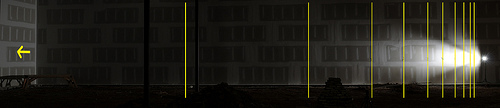
So I set out to test this. This card is made from four different scenarios - each show how light expands (and falls off) depending on the way we set our strobe.
The markers on the top represent the distance from the light source AKA Strobe (each mark is 50 cm). The words on the right tell the scenario under test.
First - the good news. When we use a stofen we get what we paid for - ISL in action. With a Stofen, the light is spreading from the flash in a very spherical way - hence when we double the distance from the flash (from 1 meter to two meters) we get aproximetelly1/4 of the light intensity.
Now, the not so good news - Whenever we set out flash on zoom we can throw ISL out of the window. The focusing of the light burst makes the light behave more like a narrow beam and less like a sphere. When we double the distance from one meter to two meters we lose just a little bit of light. When we double the distance again - it makes more sense, yet sampling dots on the 105mm line deviates far from ISL.
Actually, this is not really bad news - it means that we can get some nice power far away if we focus the beam.
Now, I'll admit, there's some sampling error when we are close to the strobe - please take the big version and see for yourself.
The Making Of
Luckily, I am still leaving on a construction site, this makes it easy for me to find long stretches of empty walls. The nice thing about it is that you can see the blocks - each block = 50 centimeters.
I placed the strobe on a lightstand (the 001b) and placed my D300 on a far away tripod. Strobe was triggered with poverty wizards (AKA cactus triggers).
I took a set of images that look very much alike - the only diff was the flash settings / modifier mount.
For the card I used the middle strip of each image
The blocks made it easy to mark lines 50cm apart.
For light intensity I used Photoshop's sampling tool.
Sharing Is Caring
As with my other Cheat Sheet Card, I placed the card on a CC license - feel free to print it, share it, use it in class and distribute it in general.
You may even use it to tell me I am wrong
More Reading:
- The Hard Math behind the Inverse Square Law
-
Intuitive& Practical explanation of the Inverse Square Law - Measuring by Length - Use this one for stofen-ed strobes
- I love cheat Sheets - Here are my Portrait lighting, Reflector Card and Light Falloff cheat sheets
Get the DIYP greatness via RSS, newsletter and TwitterConnect with the community: Readers Photos, Discussions, Readers Projects


Comments
Myth?
Not sure what myth you're busting here. The Inverse Square Law (ISL) holds when applied to point sources of light. The law makes no claims about other light sources.
If there's an assumption (or myth) that the ISL can be used, while ignoring its assumptions, then the fault lies with the erroneous application of the law, not the law itself. And anyone who assumes that the ISL holds for all flashes, just hasn't read enough about flashes or the ISL.
P.S. I think you meant "Myth Busted" and not "Myth Basted" in the title, but I kind of like "Basted" better.
Unfortunately, you are wrong
The light of a zoomed flash will fall off just the same as with any other modifier...if measured on-axis. If you stand to the side of a beam, you will receive less light than you would if you were standing on-axis.
What you're measuring is not the intensity of light, but the intensity of the light that is incident upon, and reflected from a wall. And because of your setup, the incident angle is changing with distance.
Near the light source, the angle between the light and the wall is almost 90 degrees, but as you get farther away, the angle becomes more shallow, allowing less light to hit the surface. This is the same effect that happens during the winter on earth. The sun is just as bright year round, but in the winter it hits certain areas at a more shallow angle than in the summer, where it is directly overhead.
To measure accurately, you should use a meter on the axis of the beam, that directly faces the light source. You will find that light falls off just like it should, regardless of the modifier.
@joshua - exactly I'm glad
@joshua -
exactly
I'm glad you wrote that, you saved me typing.
Possible fault in measuring
I think you would get more accurate results if, instead of measuring the light pattern on the wall in photoshop, you measured the light fall off going down the wall with a light meter. Try it and see if you don't see a pattern of fall off more consistent with what the law states. I haven't tried this with a modifier on a flash yet, but I have with a straight flash.
I wouldn't say you're wrong ...
... but there are so many factors that affect these measurements that I'm not even going to attempt to enumerate the possibilities.
That said, this is still a very useful exercise. The important point that you have captured though is that you can experiment and create real-world relevant observations of what the light looks like. The numbers become kind of irrelevant.
Brilliant!
Great stuff. Er, re:Stofen - ISL "inaction" or "in action"?
Sorry, I don't agree with
Sorry, I don't agree with your method to measure the intensity of the light.
With the sampling tool, you measure the reflective light of the wall. You can not be sure that the reflective area are the same all wall long. On the fourth picture, the umbrella is not perfectly horizontal and you must take this in count.
The best method for measuring the intensity is a flash meter, not the sampling tool.
I've made measure with this kind of instrument (the meter) and the ISL was not broken, even if I used collimated beam.
But, of course, if this kind of card matches your work method, it's ok for me but keep in mind that laws of physic can not be broken, everywhere in the universe (except in a black hole).
ps: sorry for my not so good english, it is not my native tongue.
Your method doesn't work
Unfortunately your method won't work unless you set the exposure of each image so that the brightest value that you read is less than 255. A measurement of 255 just means that the image is pure white, with no detail (ie. you've blown the highlights in your image).
The amount of light is still much much higher at 1 cm away from the flash than at 2 cm, but in all of these images photoshop will measure 255 at both locations. That doesn't mean that the inverse square law doesn't apply, it just means that your test method is broken.
Unfortunately the shadows in the wall in these images also impact what photoshop is measuring, and measuring the light on the wall *beside* the beam of light doesn't give any indication of the light output from the flash. You need to measure the actual output from the flash instead.
I think that the only way to do this right would be to use a flash meter at several distances away from the light source. I know that if you do so you will see that the ISL really does apply.
About Inverse Square Law Cheat Sheet
I think you should use flash meter, as somebody already did at Flickr
When you measure from the wall, direction of the light means a lot, especially when your surface is as broken is it is with bricks. Also reflections from walls means something. And tone curve of the camera has done the final error. If you go to place where your measurement gives zero, you shoudn't see the flash at all, right?
On 105 mm first measurement is burnt, 255 is not actual brightness. Second and third measurement follows ISL quite well. I think there is alike problems with 24 mm.
Umbrella picture follows ISL quite well, especially because you dont account reflected light and because umbrella is not point source for light
Flash is not a laser - laser do not follow Inverse Square Law. But basic flash with small reflector is - at least when we are more than 1 meter away.
ISL doesn't need spherical light but a point source and cone of light, where it can spread freely. For example light box is not point source, when it is near (neither umbrella). When there is walls near the route from flash to target, it makes reflections, and light is not spread freely.
Have an open area, where there is no wall reflections. Take a paper and place its surface straight at flash direction, Take a picture of it from the direction of the flash. Make sure you dont burn your picture. And finally you should use Raw-data and linear conversion.
But easier is to borrow a flash meter.
re: ISL concerns
Firstly, let me say that I am glad things stirred up a little. I am glad to see the response and debate that starts and I will do my best to answer all the points.
That said, I tend to agree with most commenters about the inaccuracy of the experiment and the fact that measuring light intensity using PS is really just a general indicator and not a "hard" measure. Yet, the data is pretty consistent, a strobe shoots a more focused beam of light and there for only loosely abides the ISL.
As a general comment, I'll say that one of the points of this experiment was not to use a meter (which I don't have). Yes this changes the results, however it does not change the ratios between the four samples.
@Daniel Fealko - Firstly, thanks for the typo catch! turns out basting is a cooking method ;)
As for using ISL with strobes, I could not agree more, and the fact that a strobe is not a "point of light" was the main drive for this experiment.
@Joshua Targownik - good point about the degree of light Vs. the wall - I agree that the first few centimeters are "wrong" either due to angle or due to the light being too strong (and hitting the 255 spot). However, once you move a bit from the source the angle stays more or less the same. + as you can see from the light pattern on the wall, the light is hardly spread as a ball of light, it is more of a parabolic throw pattern. Look at the diff between the 24mm and the 105mm shots. the light definitely goes further in the latter. If ILS was 100% on, both beams should have ended the same.
@Tim - Yap, a meter would have worked better. See my general comment.
@Roger Barnes - I tend to agree. Once the numbers came up, I think that they are only good as reference point and not as absolute values.
@Anon - thanks for the catch
@Sean Phillips - This is a valid point and in fact it cased me quite a headache when I was trying to decide on the correct place to set the measuring points. I tried to find a the line that will be as close to the flash as possible and with values that are lower then the dreadfully 255. On the 105mm the spot right next to the measure drops to 253, so I think it is ok to use it as a valid reference point.
@olli Rinne - thanks for the detailed explanation - I hope that my answers cover most of your points. one thing it is interesting to see the behavior at close proximity to the flash.
I hope that by this I've answered everyone, even if not addressed directly. I think that my next step would be to do this again with a (borrowed) flash meter.
I hope to keep this discussion going, please share your thoughts.
A more valid test
A more valid test would be to shoot your grey card being directly illuminated by the flash at different distances, and using Photoshop to measure the light on the card. The wall simply isn't a subject the way your lights are currently being handled. I can grudgingly forgive someone who doesn't have a decent strobe meter, but a $5 18% grey card should be in any photographer's kit.
Point of light
Many mentioned that strobe or umbrella is not point light source. That is true, but you can think of it as a collection of point light sources. So on average a non point light source still obeys the ISL when the measurement is done at a distance.
Max
One more thing that's wrong in your test
Previous commenters have pointed out various problems with your test setup. But there's one major thing that I didn't notice in the comments:
The value of a pixel in the image is not the same as light intensity, not even light intensity reflected from the brick. The camera's sensor measures light in a linear fashion, but the tone curves used to produce the final image are very non-linear. I'm talking about gamma and also the S-curve usually applied to sensor data to enhance mid-tone contrast. The end result of these curves is that you cannot use pixel values for you measurement. Halving the amount of light does not divide the pixel value by two.
P.S. An exellent book about photographic lighting and how light behaves is "Light -- Science & Magic" by Fil Hunter, Steven Biver, and Paul Fuqua. After reading it you might have a better idea how light works in photography and why inverse-square law doesn't seem to hold in every case, when in fact it does.
Another way of putting this across
Check out Zack Arias' description of the inverse square law:
http://www.zarias.com/?p=101
It's spot on.
Call Mythbusters..... Kidding....
I think you have some errors taking measures.
The method applied doesn`t take a correct measure of the light intensity.
For take a proper metering you must read light on a surface located on light source axis and perpendicular to the light source.
Is an interesting question: prove the ISL
Some time ago I made some experiments, I think this method can measure more accurately the light intensity
http://www.flickr.com/groups/taller_de_fotografia/discuss/72157622128338...
(is in Spanish, but I can translate it I some of you want)
http://www.flickr.com/photos/tonyarrj_strobist/3881887182/
comments are welcome =)
I am glad to see you
I am glad to see you experimenting with the light sources and taking the time to provide us with your observations.
Just a couple of comments.
Light reflecting off a wall is not at a constant angle from source and therefore its reflectance will vary depending on this angle.
I would suggest a better method is to set up in a field and with discs placed at evenly spaced distances and each disk at an angle to reflect light back at camera will give you a more accurate measure of light intensity drop off.
I still think your results are probably in the right ball park though.
Niels
Good article and visual explantion
Maybe the measurement could be more acurate
but your " cheat " card is great ! Everybody
can benefit from it without all the technical stuff.
re: cheat card
Thanks for the cheer, Jacob. Sadly my prosecutors are right. there a roundup of explanations as well as a corrected sheet here.
Post new comment