











Studio @ Home – Full Scale Backdrops & Backgrounds
Jun 18, 2009
Udi Tirosh
Udi Tirosh is an entrepreneur, photography inventor, journalist, educator, and writer based in Israel. With over 25 years of experience in the photo-video industry, Udi has built and sold several photography-related brands. Udi has a double degree in mass media communications and computer science.
Share:
 On the last post we saw how easy it is to set a “backdrop” for any small object.
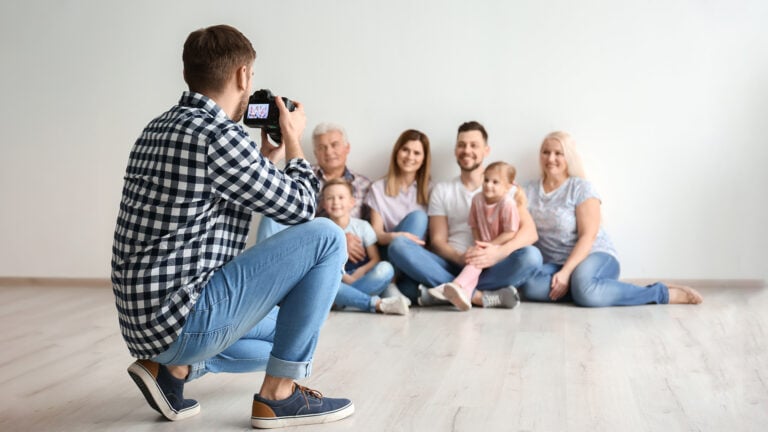
In this post, we will continue to explore backdrop solutions, only this time the focus is going to be on full scale backdrops. The type that goes better with taking portraits.
The underlying principles remain the same: once you have a space to shoot at, you will want to remove distractions from the background. Again, you’ll want to use a seamless backdrop removing seams in Photoshop is a painful and time consuming process. The standard width for most backdrop, muslin or paper is about 108″ (although 53″ is a common size as well). This width allows for some freedom in terms of subject placement and subject movement.
As with most simple things in life backdrop creation can be divided into two parts: creating the backdrop and mounting it.
FOLLOW THIS SERIES OF ARTICLES!
BACK – Small Backdrops & Backgrounds
NEXT – Easy Lighting
Backdrop Material
The main two options are muslin and paper. There are more options like canvas and others but muslin and paper are the common ones and there when I am going to focus.
Seamless Paper
Not much to say about DIYing paper on large scale, however, I did hear about a guy who got a roll from a copy-store that was wide enough to work with for a ridicules price. I tried that myself and could not find any roll wider than 1.1 meters (about 43″). Not wide enough for me. An online search does come up with some wider (54″) paper options which are way cheaper that their photography-marked relatives – just look for wide format paper rolls. (Related products on Amazon | B&H)
Seamless Muslin
If you decide to go muslin, there are definitely more buying options for you here. The trick is to buy the wide muslin. If you are shopping at a fabric store ask for a 108″ wide fabric. This is wide enough. Your two best options are pro fabric stores like Joann, or the bedding section in IKEA / Home Depot – both have ample white muslins. (Related products on Amazon | B&H)
Ready Made
 The last option, is borrowed from the traveling photographer’s toolbox. Travel photographers often share the same headaches as us home dwelling photogs: They need to setup and tear down a lot so one gear objectives the speed of setting up / tearing down a “location”. Many time traveling constrains impose of the size of the gear it its “folded mode” so packing to small size is also a goal.
This is why you’ll see a lot of photogs using a collapsible backdrop. A collapsible backdrop a muslin backdrop that is mounted of a hard wire frame. It may be as big as 6X7 feet and folds down to about a third of its size. The nice bonus on this backdrop is that it needs no mounting system and can be easily taken with you to an “off location” session. It also folds flat and nice behind a door or under a bed.
(Related products on Amazon | B&H)
Applying Color To The Backdrop
The Basics
I recommend going with two very basic colors at start: black and white. There are several reasons: Firstly, both colors are very common both for portraiture and for product photography. Also, both colors can be easily tweaked with gelled light (more on that in a bit).
Basic (non B/W) Colors
 The most trivial way to give some color to your (soon to pass away) white backdrop is to dye it. (This, naturally, works better with muslin). You can buy dying powder/liquid at any fabric store, I used RIT on several occasions and had great success.
After a quick boil and a huge tub you have the backdrop right where you wanted – not white. You can mix and match the colors in the tub to get a very specific cast. You can even go Tie-Dye on poor white and get a backdrop that is very common with portrait photographers.
Using Gelled Strobes
 The last option that I am going to discuss is to apply color to your backdrop is using a gelled strobe. A gelled strobe can produce almost any color you desire. It works by covering your flash with a small piece of colored gel at the color of your choice. A sample from a Rosco Swatchbook works great here.
You will have to take special care and make sure the light is only going towards the backdrop and not towards your subject. Otherwise your subject may end up with some rim lights the “color” of your backdrop. You can block the light with a gobo or snoot.
 Or, if you place the strobe and gel between the subject and backdrop and make sure the strobe is pointing directly at the backdrop, you can drop the gobo/snoot.
Surprisingly, this method works great with black backdrops. This is because the black absorbs all the light from the strobes leaving only the color.
Mounting Your Backdrops
One of the challenges of keeping a double use room is that the “room needs to look like a room” (It’s a loop, I know, but I hear this all too often from my wife) when it is not being used as a studio.
This means that everything must fold away when the room is not is studio mode. This, in turn, means that your backdrop system has to be designed is a way that will allow you to store it away when you are not shooting one hand, and to quickly mount a backdrop on the other.
J Hooks And Paper Backdrops
 A “J hook” is simply a hook that is shaped like the letter “J”. A couple of J hooks can be very useful when mounting paper roll backdrops.
“Real” seamless paper rolls are wrapped around a stiff cardboard tube, very much like toilet paper. Since this is the case, a toilet paper mount can be applied here as well. The first thing you need are two J hooks. Those can be found in any hardware store (IKEA | Home Depot). Those two hooks should go on the wall / book shelf in a width just a bit more than the width of the paper you’re gonna use. You’ll have to admit (and so will your significant other), those are no so ugly.
Next thing you’ll need is a pipe. I tend to go with PVC pipes for this, but any pipe will do, as long as it is longer than the roll paper.
From now on it is much like TP: thread the pipe into the roll and mount it on the hooks.
Clamps And Muslin Backdrops
It is a bit harder when it comes to muslin backdrops. It is so easy with paper rolls since they are stiff. Muslin on the other hand is fluffy and tends to fold.
I use a combination of two methods to keep the backdrop hang and straight:
 First thing demands a bit of preparation. I took a long piece of wood and attached it to one side of the muslin. This assured me that at least one side of the roll will always be straight and non-folded.
It also provides a base for rolling the muslin when it is not being used. This way it does not get wrinkled.
 I mount the backdrop on our IKEA book shelves with a set of clamps. I use four clamps (yep it is a long book shelf) to make sure I get a good grip on the entire length of the muslin.If you try hard you can see one clamp on the right, and another on the left, right below the face thingy.
The best thing would be to attach wood on both ends of the muslin, however, I only attached one. For this reason, I keep the wood part on the floor. This provide straight ends both on the floor and on the mounting point, which in turn helps to remove folds and wrinkles from the fabric. To make the setup more durable, I also gaffertape the backdrop to the floor in several locations.
Further Reading:
– Very Cheap Backdrop holder for Your Room or Living Room
– White Seamless Tutorial :: Part 1 :: Gear & Space
– How to Build a Studio Setting in Your own Home
– DIY Ghetto-Fab Portable Backdrop Stand
What’s Next?
Do you have a system to hang backdrops? do you have a secret backdrop trick that you’d like to share? We’d love to hear it, so hit the comments.
First assignment of Studio @ Home is coming next, so stay tuned.

Udi Tirosh
Udi Tirosh is an entrepreneur, photography inventor, journalist, educator, and writer based in Israel. With over 25 years of experience in the photo-video industry, Udi has built and sold several photography-related brands. Udi has a double degree in mass media communications and computer science.
Related Posts
 Studio @ Home – Small Backdrops & Backgrounds
 6 Awesome Home Studio Tips: Backdrops To Lights And More
 Home Studio Photography: Your Complete Guide To Building A Photography Studio At Home
 How to use a gym bag full of old mobile backdrops to turn any office into a proper studio for corporate headshots
Join the Discussion
DIYP Comment Policy
Be nice, be on-topic, no personal information or flames.
One response to “Studio @ Home – Full Scale Backdrops & Backgrounds”
I love muslin backdrops. This material is a great choice for backdrop. Most of them are washable. And it is stiffer than other styles. I have bought some backdrops from the here: https://www.dbackdrop.com/ whose material is exactly muslin, featuring printed bright colors, light weight, glare free, foldable and no crease. You can iron them with low temperature or throw them in the washer and dryer. Cleaning is easy.