









Studio @ Home – Space
May 27, 2009
Udi Tirosh
Udi Tirosh is an entrepreneur, photography inventor, journalist, educator, and writer based in Israel. With over 25 years of experience in the photo-video industry, Udi has built and sold several photography-related brands. Udi has a double degree in mass media communications and computer science.
Share:
 In this installment of Studio @ Home we will deal with the most fundamental aspect of having a home based studio – space.
When dealing with studio space can be easily overlooked while taking care of all the musts: camera, lighting, backdrops, props and more. But the fact of the thing is, you cannot have a studio if there is no studio space. So, how much space do you need?
FOLLOW THIS SERIES OF ARTICLES!
BACK – Studio @ Home – What Does It Take?
NEXT- Studio @ Home – Show Us Your Space
How Much Space Do You Need?
More!
You can always use more space. You need to use a longer lens, to setup more lights, to have better subject to background distance. You can always use more space. And once you have the space you need, you will want more space to have a makeup/styling corner, a dressing room, a prop closet.
The smarts of it is to know how to do it with less space. What can you fold away? Store aside? How can you use existing furniture and house elements as integral parts of your studio? We will discuss all of those questions in upcoming articles, but I still have a question to answer. Space.
So how much space do you really need? It depends.
For small objects and eBay items you could probably get away with one meter by two meters. That means that you can most likely shoot on your bed after placing something to make it less bouncy (yes foamboard will work miracles here).
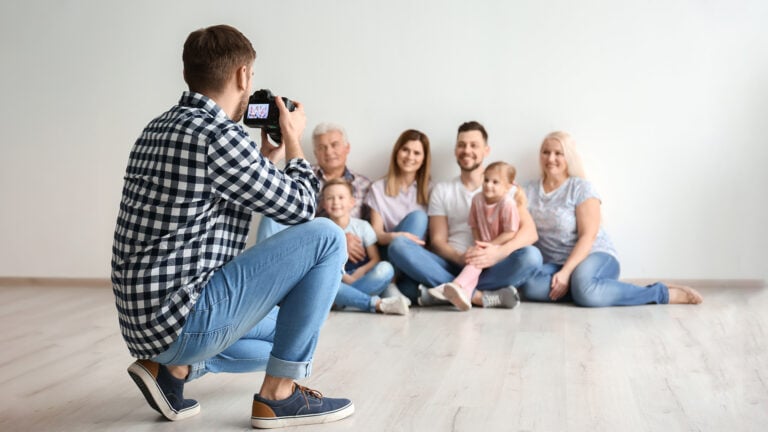
For bigger subjects and more interesting setups you will need more space. Two meters width is a good start for a home studio. Length of two, two and a half meters will enable you to shoot most still life (refrigerators excluded) and most kids and babies. Three and a half meters should do for almost anything.
Now, I assume that not all of us have our own dedicated room to play studio at. The good news is that most living rooms are well sized for this job.
From Living Room To Studio
 As you can see on the left, my living room doubles as a studio. This means that I can use it for photography, on evenings, when the missus and kids sleep, and on weekends when the bunch shows me mercy and go out for a while I kick everyone out of the house.
One important aspect of making a dual use space is storage. When the room is at its natural non-studio position, you’d like to keep everything folded away nicely, so you’ll get the most out of your space.
Here are a few work/thought items that can help you get your living room double as a studio studio double as your living room.
Table Top
For shooting still life and product shots, you need a surface. Look around you – the first surface that comes to mind is probably the floor. This will work for some items, however there are some disadvantages:
– You are pretty restricted anglewise. You can shoot from above, and if you lie down flat, you can shoot horizontally. Not comfy.
– You cannot shoot from blow.
Next closest surface is the leaving room table. Now we are talking some comfort. This is what I used in the image above.
You can put a tripod in place, and shot and a reasonable angle. You can comfortably place a sheet of paper for backdrop/”floor”. And the best thing – it is available. Always.
 Next option, which is a personal favorite, is using a couple of sawhorse. I use a set of two sawhorses that cost about 10$ together.
They fold nice and easy into a hidden location. I usually place wooden flat board on top and have instant table top to shoot on. I have two of those a small one about a meter wide and a monster almost 3 meters wide, which I store near the laundry lines.
On occasions, I’ll also place a glass plate on top to shoot from below.
A nice bonus to using sawhorses and boards is that you can easily use clamps on the boards, without fear of nuking the furniture.
Walls
Gotta have ’em. There are two things to note about walls – existence and color.
Existence – if you’ll take another look at the setup image above, you’ll notice there are no walls. Library – yes; TV space – yes; Free walls – no.
Having one free wall is great. For one thing, you can setup a backdrop mounting system on a wall. You can also set it up as a huge white reflector, use it a huge reflector. If you have a backdrop which is setup against a wall, it is possible to lean on it, a thing that models often do.
If you have two walls – a corner, you are even better. You can setup a small portrait zone with a single flash.
BUT! You don’t always have walls. I’ll discuss this in great length on the backdrop post.
 Reflections – if you ever shot glass, metal or other reflective subjects you’ll know what I am talking about. A library like mine reflects on metal like laser aim on a Schwarzenegger movie. So it is best to keep the walls clean. I know, on a living room this is not always an option.
This is why I have a way of completely covering this “wall” with black (which also serves as ad-hoc backdrop).
Another thing that has great influence on your space is the presence, lack and direction of windows. If you do have window, you can get some great smooth light on certain times of the day. You also need to make sure you can block the light coming from it – window light can become an issue for long exposures or other occasions where you’ll want to control light.
Backdrop System
You’ll need backdrops. Even more relevant to this post, you’ll need places to mount those backdrops on. While this can be easily solved for small objects, by simply using a piece of paper, it is a real concern when dealing with people.
Having no walls never stopped me from having a backdrop system, and there will be a dedicated post for backgrounds, backdrops and home brew mounting systems.
For now, I’ll just say that wide sheets of muslin are easier to get then you may think and that IKEA is your best friend when it comes to mounting systems.
Flooring
I had one question about flooring. It was from a guy who has fitted carpet all over the place, and wanted something more firm to work on. Again this is no issue for table top photography, but is a real concern f you don’t want your seamless paper torn when your model punches her high hills on it.
The one idea that we tossed was to place tileboard on the floor before shooting. Those can easily be stored away.
Hideaway Lights
You must be able to adios your lights when the shooting is done. This is another topic that will get several dedicated posts. We will discuss hotlights, CFLs, Florescent bulbs and small strobes. We will also discuss some home made light control options. All of which must be tacked away when shooting is done.
Share Your Space
Are you shooting at home? Post your shooting space, and any ideas, rants and thoughts on this Flickr thread.
Further Reading:
– Strobist – Headshot in a Corner.
– DIYP – Really Cheap Homemade Studio – This really the basic of basics.
– My Photo Setup – Garage turned into class A bicycle studio
Make sure you don’t miss out on the next article – Register to the RSS feed or the newsletter.

Udi Tirosh
Udi Tirosh is an entrepreneur, photography inventor, journalist, educator, and writer based in Israel. With over 25 years of experience in the photo-video industry, Udi has built and sold several photography-related brands. Udi has a double degree in mass media communications and computer science.



Join the Discussion
DIYP Comment Policy
Be nice, be on-topic, no personal information or flames.